Leave A Message
Leave A Message


How to Verify BSCI Certified Supplier: Step-by-step Guide to Check Real amfori BSCI Factory Meta Description: Wondering how to verify BSCI certified supplier? Learn how to check DBID number, audit grade, expiry date and spot fake BSCI certificates for your wholesale sourcing.
How to Verify BSCI Certified Supplier: Step-by-step Guide to Check Real amfori BSCI Factory
When sourcing wholesale home decor, garden sculptures or handmade crafts from China, many suppliers claim they hold BSCI certification. However, fake BSCI certificates are common. Simply viewing a PDF certificate or logo on their website is not enough to confirm validity.
This practical guide explains how to verify BSCI certified suppliers through the official amfori BSCI platform, what key details to check, and red flags of fake certificates.
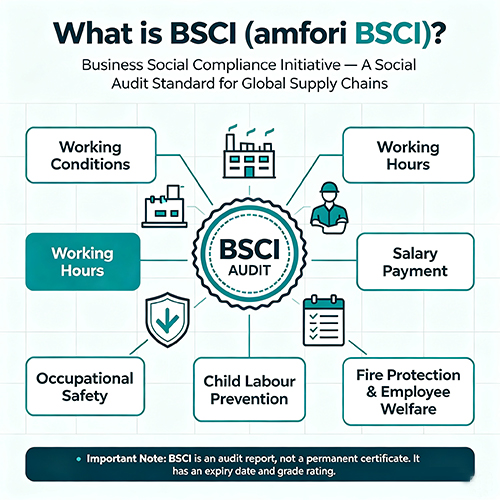
BSCI stands for Business Social Compliance Initiative, managed by amfori. It is one of the most widely accepted social audit standards for global supply chains. A BSCI audit evaluates factory working conditions, working hours, salary payment, occupational safety, child labour prevention, fire protection and employee welfare. Many European retailers require their manufacturers to pass BSCI audit before cooperation.
Important note: BSCI is an audit report, not a permanent certificate. It has an expiry date and grade rating.
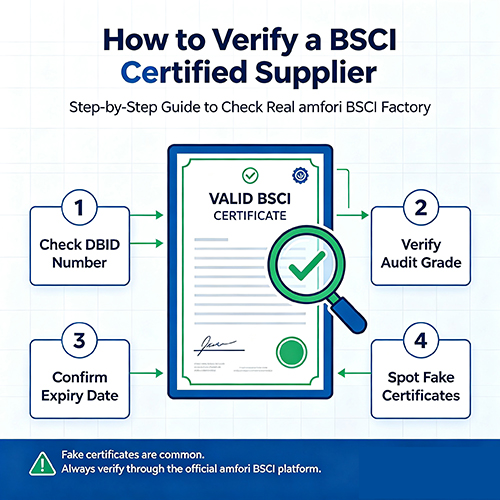
The first thing to request is the factory’s DBID (Database ID). Every factory with a valid BSCI audit has a unique DBID number registered on the amfori platform. Without DBID, you cannot verify the audit record officially.
Also request these supporting documents:
· Full BSCI audit report
· Audit issue date & expiry date
· Final audit grade (A / B / C / D / E)
· Auditing company name (SGS, Intertek, BV, TÜV Rheinland etc.)
· Audited factory address (must match actual production site)
1. Log into the amfori sustainability platform (you need amfori member access to view full audit data).
2. Input the supplier’s DBID number.
3. Cross-check the factory name, registered address and production scope.
Key points to check: ✅ Audit status: Valid / Expired ✅ Audit grade:
· A / B: Good performance, audit valid for up to 24 months
· C: Acceptable, requires corrective action
· D / E: Failed audit, high social compliance risk ✅ Audit scope: Confirm the audit covers the product category you order (MGO sculpture, home decor etc.) ✅ Auditor: Only amfori-approved audit bodies are legitimate
If the DBID cannot be found on amfori platform, the BSCI document is fake.
Even if DBID exists, you still need to read the full report:
1. Confirm the factory address matches the real manufacturing plant, not a trading company address.
2. Review non-conformities and the CAP (Corrective Action Plan). Severe non-conformities may mean high supply chain risk.
3. Check audit type: semi-announced or unannounced audit carries higher credibility than announced audit.
Watch for these warning signs: ❌ Supplier only provides a picture of BSCI logo, no DBID number. ❌ DBID cannot be searched on amfori official platform. ❌ Expired audit report (valid BSCI audit normally lasts maximum 24 months). ❌ Certificate issued by unknown non-accredited audit company. ❌ Audit address does not match production factory. ❌ The audit scope does not cover your product line.
1. Factory visit: Conduct on-site inspection to verify workshop, fire safety and working environment.
2. Request employee interview records and payroll samples from audit.
3. Require the supplier to share RSP (Responsible Supplier Permission) to let your brand view audit directly on amfori platform.
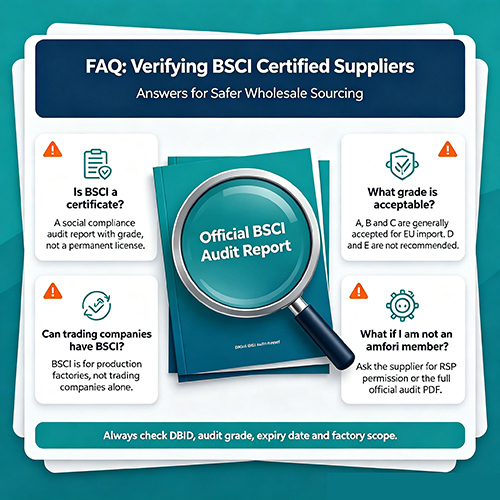
Q: Is BSCI a certificate? A: BSCI is a social compliance audit managed by amfori. It generates an audit report with grade, not a permanent certification license. It will expire after 1 or 2 years.
Q: What BSCI grade is acceptable for import to EU market? A: Grade A, B and C are generally accepted. Grade D and E mean the factory failed the audit, not recommended for cooperation.
Q: Can trading companies have BSCI certification? A: BSCI audit is for production factories, not trading companies. A trader cannot hold a BSCI audit under its own name unless it owns the manufacturing workshop.
Q: What if I am not an amfori member? A: Non-members cannot directly access full audit records. You can ask your supplier to grant RSP permission so you can view their BSCI audit, or ask them to share full official audit PDF.
Verifying BSCI certified suppliers protects your brand reputation and reduces supply chain social risk. Never trust only screenshots or logo images. Always validate DBID, audit grade, expiry date and factory scope via amfori official system before starting bulk orders.
Our MGO vintage sculpture factory holds valid BSCI audit. Contact us to get our DBID and full BSCI audit report for your sourcing review.